
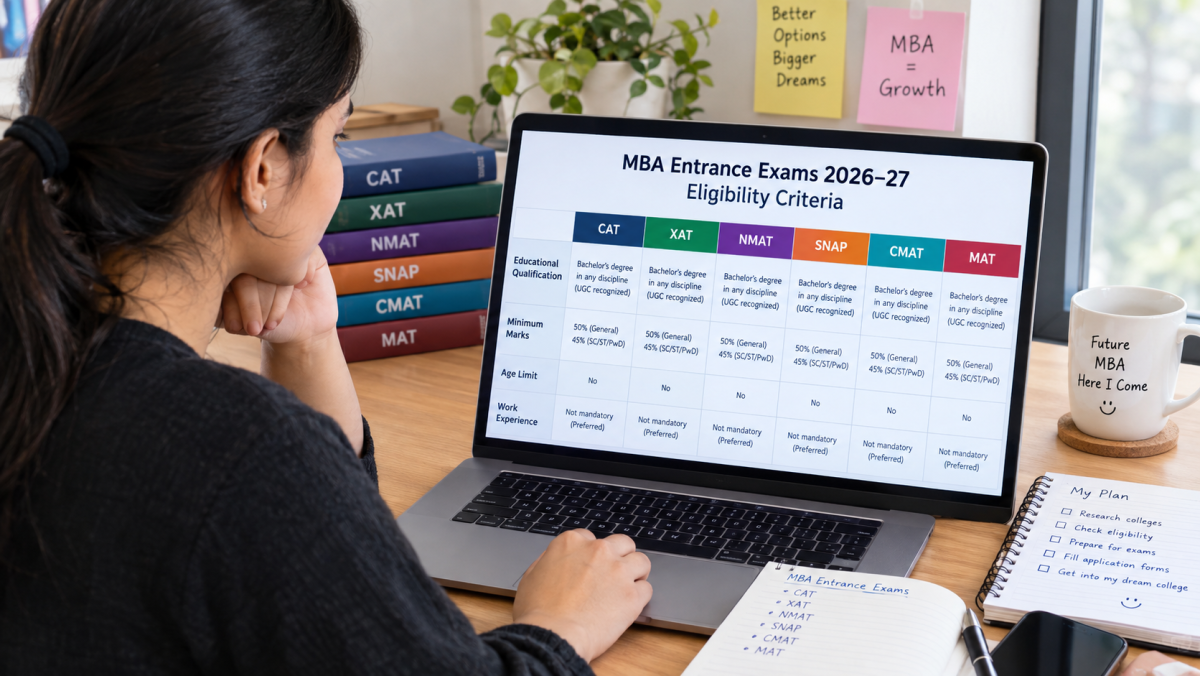
MBA Entrance Exams Eligibility 2026–27: CAT, XAT, NMAT, SNAP, CMAT & MAT
Published on: 26-Sep-2026 | Author:
Check MBA entrance exams eligibility 2026–27 for CAT, XAT, NMAT, SNAP, CMAT, MAT and more. See graduation marks, final-year rules, age limits, documents and the best exam for your profile.
MBA Entrance Exams Eligibility 2026–27: CAT, XAT, NMAT, SNAP, CMAT & MAT
Most MBA aspirants lose time preparing for an exam before checking one basic thing: are they eligible for the colleges they want? A 45% graduation score, final-year status, work experience, or a specific college rule can change your shortlist.
This guide explains MBA entrance exams eligibility for the major Indian exams in simple terms. It also helps freshers, final-year students, working professionals, and students with low graduation marks choose the right route. Pathshalahub counsellors, led by Haris Faraz with 14+ years of career-guidance experience, recommend checking both the exam eligibility and the individual college eligibility before paying any application fee.
Quick Summary
CAT requires a bachelor’s degree with at least 50% marks for General, EWS and NC-OBC candidates, while SC, ST and PwD candidates need 45%; final-year candidates may also apply provisionally.digialm+1
Table of Contents
-
What is MBA entrance exam eligibility?
-
Eligibility for CAT, XAT, NMAT, SNAP, CMAT and MAT
-
Which exam suits your academic profile?
-
Documents and application process
-
College-level rules students often miss
-
Myths, mistakes and expert advice
-
FAQs
What Is MBA Entrance Exam Eligibility?
MBA entrance exams eligibility means the minimum academic and personal requirements needed to sit for an exam. Usually, this includes:
-
A recognised bachelor’s degree.
-
A minimum percentage in graduation, where applicable.
-
Final-year completion rules.
-
Category certificate rules, if claiming reservation.
-
Individual B-school conditions after the exam.
The key point is simple: passing an exam eligibility test does not guarantee eligibility for every MBA college. For example, you may be eligible to write XAT but may still need to meet a programme-specific graduation percentage or selection requirement at the college you apply to.
Explore the full list of top MBA entrance exams in India for 2026–27 before making your exam shortlist.
MBA Entrance Exams Eligibility 2026–27
XAT accepts candidates with a recognised bachelor’s degree of at least three years, and candidates completing final examinations by the stated deadline may apply. CMAT requires a bachelor’s degree in any discipline and also permits final-year candidates. MAT accepts graduates in any discipline and provisionally accepts final-year undergraduate students, with no age bar or compulsory work experience.cdnbbsr.s3waas+2
CAT Eligibility 2026–27
CAT is the most important exam for IIMs and many top MBA colleges. You can apply if you have:
Your bachelor’s degree can be in any stream: B.Tech, BBA, B.Com, BA, B.Sc, BCA, law, pharmacy, architecture or another recognised equivalent degree. Work experience is helpful for interviews at some institutes, but it is not compulsory to write CAT.
Final-year students can apply. However, admission remains provisional until they submit proof that they have completed the degree as per the deadline set by the allotted IIM or B-school.
Want a wider shortlist beyond IIMs? Read MBA colleges accepting 80 percentile in CAT and MBA colleges accepting 70 percentile in CAT.
XAT Eligibility 2026–27
XAT is conducted for XLRI and accepted by many leading private and public B-schools. You need a recognised bachelor’s degree of at least three years in any discipline. Final-year students can also apply if they complete their graduation within the notified deadline.
Unlike CAT, XAT’s exam-level rule does not set one universal minimum graduation percentage. But the MBA programme you choose can set its own conditions. Always check the institute’s admission page before applying.
SNAP Eligibility 2026–27
SNAP is the entrance exam for Symbiosis International (Deemed University) institutes such as SIBM Pune, SCMHRD and SIOM. Eligibility can differ by programme.
For many Symbiosis MBA programmes, candidates need a recognised graduation degree with at least 50% marks, while SC/ST candidates generally need 45% marks. Some specialised programmes have degree-subject requirements, so do not assume that every SNAP-linked programme has identical eligibility.
NMAT Eligibility 2026–27
NMAT is accepted by institutions such as NMIMS and other participating B-schools. The exam itself is only the first stage; each college decides its own minimum graduation marks, sectional requirements, attempt rules and selection process.
Before registering, check whether your preferred NMIMS or partner college accepts final-year applicants and whether it requires a particular graduation percentage. For NMIMS-focused guidance, see NMIMS Mumbai MBA admission, fees and NMAT guide.
CMAT Eligibility 2026–27
CMAT is useful for AICTE-approved MBA/PGDM colleges and is accepted by many government, university and private B-schools. Candidates must have a bachelor’s degree in any discipline, and final-year students may apply.
This makes CMAT a strong option for students who want more college choices beyond CAT and XAT. Still, check whether your preferred college uses CMAT scores for the 2026–27 admission cycle.
MAT Eligibility 2026–27
MAT is conducted by AIMA and is suitable for students targeting a broad range of B-schools. You need graduation in any discipline from a recognised university or equivalent qualification. Final-year students may apply provisionally. There is no upper age limit, and previous job experience is not required.
AIMA conducts MAT multiple times a year, giving students flexibility if they miss another major exam window.
Important Dates: Planning Window
Exact 2026–27 dates can change, so students should rely on official exam portals before submitting a form.
CAT 2026 was scheduled for 29 November 2026, with registration announced for August to September in the official cycle. MAT is held multiple times each year, and its official information lists February, May, September and December sessions.aima+2
Eligibility by Student Profile
Students who do not want to take CAT should explore MBA entrance exams without CAT and the guide to MBA colleges without CAT.
Application Process Flowchart
Create account
↓
Verify email and mobile number
↓
Fill personal and academic details
↓
Select test city and preferred programmes
↓
Upload photograph, signature and certificates
↓
Pay application fee
↓
Download confirmation page
↓
Take the exam
↓
Apply separately to colleges, where required
↓
Shortlisting, GD/WAT/PI or interview
↓
Final admission offer
A major mistake is assuming that one exam form automatically applies you to every college. CAT, XAT, SNAP, NMAT and CMAT-linked institutes may require separate programme applications, fees or preference forms.
Documents Required
For CAT registration, candidates typically need academic details, a photograph, signature and relevant category documents, while final-year applicants may need a certificate from their college later in the process.careerlauncher+1
College-Level Rules You Must Check
Exam eligibility is only step one. Before spending money on forms, check these five points for every target college:
For example, an aspirant with 48% graduation may be able to write certain exams but should not assume eligibility at every premium B-school. Make a college-wise sheet before registering.
Need help building a realistic exam shortlist? Get exam preparation guidance from Pathshalahub counsellors before you spend on multiple application forms.
Which MBA Exam Should You Choose?
Do not choose an exam only because friends are taking it. Choose it based on your target colleges, graduation percentage, budget, preparation time and comfort with the exam pattern.
MBA Specialisation-Wise Direction
Students interested in data-driven roles can explore the MBA in Business Analytics scope, salary and colleges guide.
Benefits vs Drawbacks
Common Mistakes Students Make
Before choosing a private B-school or direct-admission route, read how to choose the right college in 2026 and mistakes while choosing a college.
Myths vs Reality
Who Should Choose This Route?
MBA entrance exams are suitable for:
-
Graduates who want structured entry into recognised MBA/PGDM programmes.
-
Final-year students planning an MBA immediately after graduation.
-
Working professionals seeking a career switch or faster growth.
-
Students targeting IIMs, XLRI, Symbiosis, NMIMS, university departments or strong private B-schools.
-
Parents seeking clearer proof of a college’s selection process and placement track record.
Who Should Avoid This Route?
A full-time MBA entrance-exam route may not be ideal for:
-
Students who are not yet clear about their career direction.
-
Candidates unable to afford programme fees without a realistic loan-and-ROI plan.
-
Working professionals who need to continue earning and may be better suited to an executive, online or part-time option.
-
Students choosing MBA only to avoid making a career decision.
If you are comparing formats, read online MBA vs regular MBA in India.
Best Option by Budget
For low-fee choices, compare MBA colleges under ₹5 lakh and MBA colleges under ₹10 lakh.
Best Option by Career Goal
Expert Tips From Pathshalahub
According to Haris Faraz, Career Counsellor with 14+ years of experience, students should build their MBA plan in this order:
-
List your preferred specialisation and career goal.
-
Check graduation marks and category eligibility.
-
Create a mix of dream, target and safe colleges.
-
Select three to five entrance exams linked to those colleges.
-
Track both exam forms and separate institute applications.
-
Compare colleges on total cost, average placement, recruiter quality and loan burden.
A strong score matters, but a smart college shortlist often matters just as much.
Get exam preparation guidance from Pathshalahub if you need a personalised CAT, XAT, SNAP, NMAT, CMAT or MAT strategy based on your marks and target colleges.
FAQs
What is the minimum qualification for MBA entrance exams?
A bachelor’s degree from a recognised university is the standard qualification for most MBA entrance exams. CAT, XAT, CMAT and MAT accept candidates from any academic stream, subject to their stated conditions.xlri+3
Can final-year students apply for MBA entrance exams?
Yes. CAT, XAT, CMAT and MAT allow final-year students to apply provisionally, but admission depends on completing graduation and submitting documents by the institute’s deadline.xlri+3
What is the CAT eligibility percentage?
For CAT, General, EWS and NC-OBC candidates need at least 50% in graduation. SC, ST and PwD candidates need at least 45%.digialm+1
Is there an age limit for MBA entrance exams?
Most major MBA entrance exams do not impose an upper age limit. MAT specifically states that there is no age bar.
Can I do MBA after BA, B.Com or B.Sc?
Yes. MBA entrance exams generally accept graduates from arts, commerce, science, engineering, law and other recognised disciplines.xlri+2
Is work experience compulsory for CAT or MBA admission?
No. Work experience is not compulsory for CAT or most full-time MBA programmes, although it can strengthen your profile in some selection processes. MAT also confirms that job experience is not necessary.
Can I apply for CAT with 45% in graduation?
You are eligible for CAT with 45% if you belong to SC, ST or PwD categories. General, EWS and NC-OBC candidates need 50%.digialm+1
Which MBA entrance exams should I take if I do not want CAT?
Consider XAT, SNAP, NMAT, CMAT and MAT based on your target colleges. Each exam serves a different group of institutes and has different selection processes.
Does clearing an MBA entrance exam guarantee admission?
No. Colleges may consider exam score, sectional cut-offs, academic record, work experience, written tests, group exercises and personal interviews.
Can a student with low graduation marks still do an MBA?
Yes, but choices may be narrower. Check institute-specific percentage requirements and focus on exams and colleges that match your academic profile.
Final Recommendation
Choosing the right exam route can save you a year, several application fees and a costly college mistake. Start with your graduation eligibility, then shortlist exams based on the colleges and career outcome you actually want.
Reviewed by Haris Faraz — Career Counsellor with 14+ Years of Experience | Pathshalahub

Discussion (0)
Add Comment
No comments yet. Be the first to share your thoughts!