
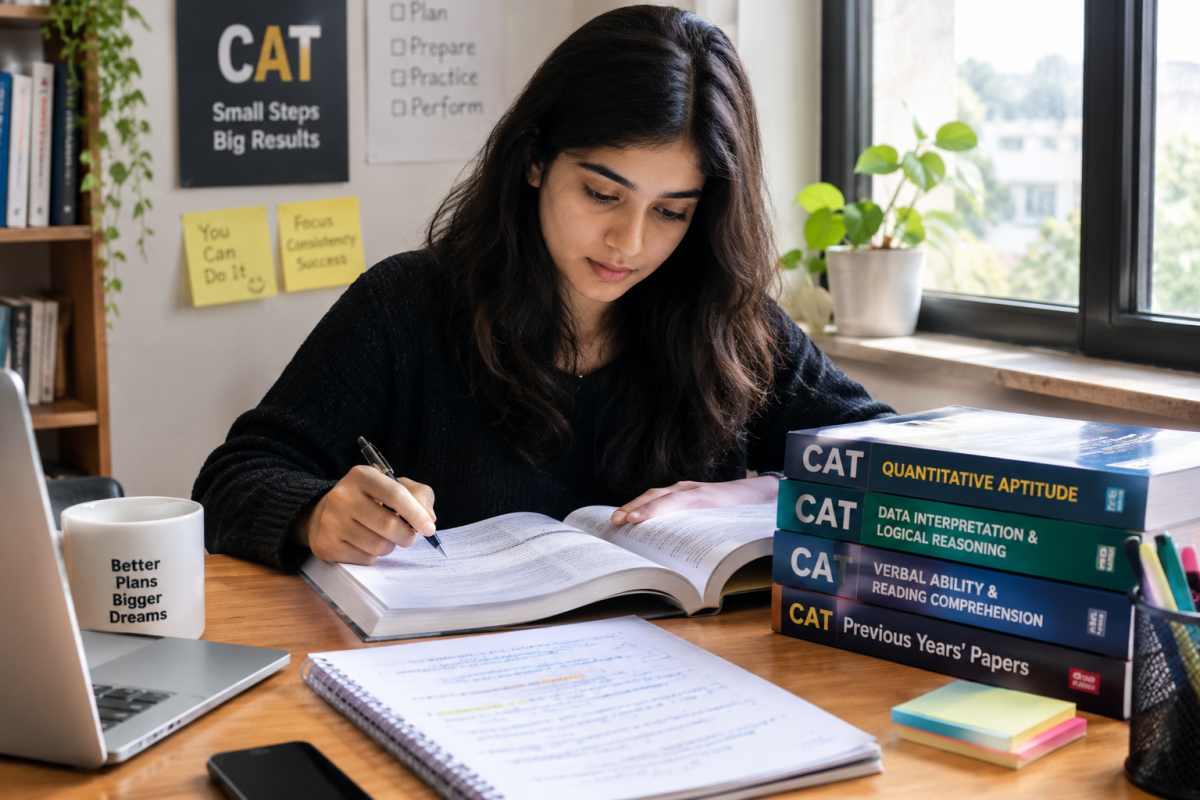
Best Books for CAT Preparation 2026: Section-Wise Booklist, Strategy & Free Resources
Published on: 01-Oct-2026 | Author:
Find the best books for CAT preparation 2026 for VARC, DILR and Quantitative Ability. Compare beginner and advanced CAT books, avoid common mistakes, and build a practical study plan.
Best Books for CAT Preparation 2026: Section-Wise Booklist and Strategy
Most CAT aspirants do not fail because they bought the “wrong” book. They struggle because they collect five books for every section, delay mock tests, and never build an error log.
The best books for CAT preparation are the ones you can complete, revise, and practise under a timer. CAT is a computer-based aptitude test with three timed sections: Verbal Ability and Reading Comprehension (VARC), Data Interpretation and Logical Reasoning (DILR), and Quantitative Ability (QA). The recent CAT format used a 120-minute test with 40 minutes per section, so choosing practice material that supports timed solving matters more than chasing theory alone.news.careers360+1
Pathshalahub counsellors, led by Haris Faraz with 14+ years of career-guidance experience, recommend a simple resource stack: one main book per section, CAT previous-year questions, and a reliable mock-test series.
Need help choosing a CAT strategy based on your current level and target percentile? Talk to a Pathshalahub counsellor for personalised guidance.
Table of Contents
-
Best CAT books section-wise
-
How to choose books by preparation level
-
CAT 2026 preparation flow
-
Books versus mocks: what matters more?
-
Common mistakes and myths
-
Best option by budget and career goal
-
FAQs
CAT 2026 Overview
CAT is used by IIMs and many other Indian business schools for MBA and related postgraduate admissions. It tests reading ability, reasoning, data interpretation, arithmetic, algebra, geometry, number systems, and decision-making under strict time limits.iimk+1
CAT notifications, dates, test cities and application rules are announced on the official CAT portal. Do not rely only on old social-media posts or coaching advertisements for deadlines.iimk+1
Important CAT 2026 Dates
The CAT 2026 notification had not been officially published at the time of writing. Use the following timeline only as a planning guide based on the recent CAT cycle, and verify all final dates on the official portal.
For context, CAT 2025 registration began on 1 August, and the examination was held on 30 November in three sessions.iimcat+1
Best Books for CAT Preparation: Section-Wise List
VARC Books for CAT 2026
VARC rewards regular reading and clear reasoning. A vocabulary book can help, but it cannot replace daily reading comprehension practice.
Popular CAT resource lists consistently include Arun Sharma’s VARC material and Word Power Made Easy, while also stressing CAT papers for real exam-level practice.shiksha+1
DILR Books for CAT 2026
DILR is less about memorising formulas and more about recognising which sets to leave. Start with easy arrangements and tables before moving to mixed, high-pressure sets.
Quantitative Ability Books for CAT 2026
For QA, build arithmetic first. Percentages, ratios, averages, profit and loss, time-work, time-speed-distance, and mixtures appear often in CAT-level preparation plans.
Arun Sharma, Sarvesh K. Verma and Nishit K. Sinha are commonly recommended authors for CAT quantitative and reasoning preparation.collegedekho+2
Which CAT Books Should You Buy?
Do not buy every title in the table. Choose based on where you are starting.
Best practical combination for most students: Arun Sharma books for QA, DILR and VARC; previous CAT papers; and one quality mock-test series. That is enough if used seriously.
If CAT is only one part of your MBA plan, explore MBA entrance exams, eligibility and dates for 2026–27 before choosing forms and exams.
CAT Preparation Process Flow
Diagnostic mock
↓
Identify weak topics and accuracy level
↓
Choose one book per section
↓
Complete concepts and untimed practice
↓
Start sectional tests
↓
Solve previous-year CAT questions
↓
Take full-length mocks
↓
Analyse errors and revise
↓
Build final exam attempt strategy
The important part is the step many students skip: mock analysis. For every wrong or skipped question, mark whether the reason was concept gap, calculation error, poor set selection, time pressure, or careless reading.
Books vs Mocks: What Should Get More Time?
A book teaches a method. A mock teaches you whether you can use that method under time pressure. Since CAT has separate timed sections and restricted movement between them, section-wise tests should begin well before the final month.ndtv+1
For a focused last-month approach, read Pathshalahub’s CAT preparation in one month strategy, daily plan and mock tips.
Best Study Plan Using These Books
A good weekly target is:
-
4–6 RC passages
-
8–12 DILR sets
-
80–120 QA questions, depending on difficulty
-
One revision session from your error notebook
-
One sectional test or mock, followed by detailed analysis
Common Mistakes Students Make
Myths vs Reality
Students who want alternatives should compare MBA colleges without CAT for 2026–27 before making a final application plan.
Who Should Choose CAT?
CAT preparation is a good fit for:
-
Graduates aiming for IIMs and leading Indian B-schools.
-
Students comfortable improving aptitude through regular practice.
-
Candidates targeting consulting, finance, marketing, operations, analytics or general-management roles.
-
Working professionals who can follow a disciplined evening and weekend routine.
-
Students seeking a high-ROI MBA pathway through public IIMs and reputed private schools.
Who Should Avoid Depending Only on CAT?
CAT alone may not be ideal for:
-
Students who will not have time for several months of practice.
-
Candidates uncomfortable with a single high-pressure test outcome.
-
Students who need a wider college-application safety net.
-
Applicants targeting institutes that primarily accept XAT, NMAT, SNAP, GMAT or CMAT.
-
Students who have not considered fees, location, specialisation and placement goals beyond a percentile.
A smart MBA applicant generally keeps more than one entrance route open. Use Pathshalahub’s CAT percentile vs MBA college guide to turn your target score into a realistic shortlist.
Best Option by Budget
Avoid joining expensive coaching only because friends have joined. First take a diagnostic mock. If you can study independently and analyse mistakes honestly, books plus mocks may be enough.
Best Option by Career Goal
If your expected score is around 70 percentile, check MBA colleges accepting 70 percentile in CAT. For an 80-percentile target, use this guide to MBA colleges accepting 80 percentile in CAT.
Expert Tips from Pathshalahub
As Haris Faraz and the Pathshalahub counselling team advise, do not judge a book by how difficult it looks. Judge it by whether you can:
-
Finish its core exercises.
-
Review every mistake.
-
Apply the learning in a timed sectional.
-
Improve your accuracy over four to six weeks.
For CAT, resource discipline beats resource collection. Finish one source, revise it, then use mocks and past questions to test whether the learning transfers to exam conditions.
Unsure whether CAT, XAT, NMAT, SNAP or CMAT suits your profile? Talk to a Pathshalahub counsellor for student-first guidance.
Final Recommendation
FAQs
Which is the best book for CAT preparation 2026?
For most aspirants, Arun Sharma’s CAT series is a practical starting point because it offers section-wise, graded practice. Add previous CAT papers and a quality mock series instead of buying several overlapping books.shiksha+1
Is Arun Sharma enough for CAT preparation?
Arun Sharma books can provide a strong base, especially for QA and DILR. They are not enough by themselves because CAT performance also requires timed sectionals, previous-year questions, mocks and detailed error analysis.
Which book is best for CAT Quantitative Ability?
Arun Sharma’s How to Prepare for Quantitative Aptitude for CAT is a useful primary resource. Quantum CAT by Sarvesh K. Verma can be added if you want more detailed theory and extra practice.mbauniverse+2
Which books are best for CAT DILR?
Use Arun Sharma’s books for Data Interpretation and Logical Reasoning as your base. Then shift quickly to CAT previous-year sets and mock-test sets, because DILR improves most through repeated timed solving.
How many books should I buy for CAT?
Buy only one main book for each section, plus a mock series. Most students need three core books, previous-year CAT questions and regular mock tests—not a large collection.
Can I prepare for CAT without coaching?
Yes. Self-study can work if you follow a weekly timetable, take mocks consistently, analyse mistakes and seek help when stuck. CAT is a computer-based test with timed sections, so your practice must include timed computer-style tests.iimcat+1
Are previous-year CAT papers important?
Yes. They help you understand question style, difficulty, time pressure and section-wise patterns. Use them after learning the basics and again during the mock phase.
When should I start CAT mocks?
Take one diagnostic mock at the beginning. Start regular sectional tests after basic concepts begin to settle, then increase full-length mocks in the final two to three months.
Is vocabulary enough for VARC?
No. Vocabulary helps, but CAT VARC mainly demands reading comprehension, inference, logical elimination and careful interpretation of passages.
What should I do if my CAT mock scores are low?
Do not change books immediately. Review the mock and identify whether the issue is weak concepts, poor question selection, low accuracy, slow calculations or panic under time pressure. Work on one cause at a time.
Reviewed by Haris Faraz — Career Counsellor with 14+ Years of Experience | Pathshalahub

Discussion (0)
Add Comment
No comments yet. Be the first to share your thoughts!