
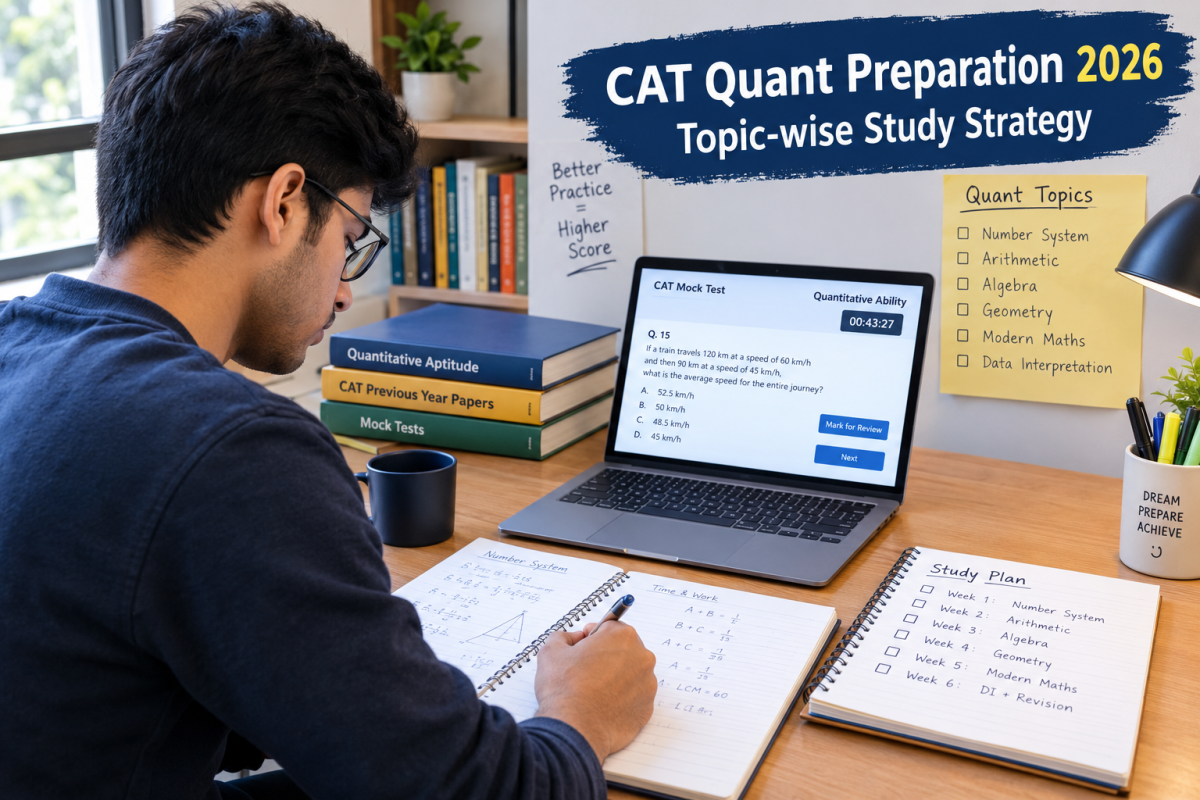
CAT Quant Preparation 2026: Complete Topic-Wise Guide, Strategy & Study Plan
Published on: 03-Oct-2026 | Author:
Master CAT Quant preparation for 2026 with topic-wise priority, study plan, question strategy, books, mocks, common mistakes, and expert tips for CAT Quantitative Ability.
CAT Quant Preparation 2026: Complete Topic-Wise Guide
Most CAT aspirants do not struggle because they “cannot do maths.” They struggle because they prepare CAT Quant like a school exam: they finish chapters, memorise formulas, and then get stuck when CAT asks a familiar concept in an unfamiliar way.
CAT Quant preparation is about choosing the right questions, building number sense, and solving with calm under a 40-minute sectional limit. Recent CAT papers have had 22 QA questions, including MCQs and TITA questions, with Arithmetic and Algebra contributing the largest share in most slots.careers360+1
This guide helps you decide what to study first, how much time to give each topic, how to use mocks, and how to improve even if maths has been your weak area. Pathshalahub counsellors have worked with MBA aspirants across different academic backgrounds, including engineers, commerce graduates, working professionals, and students restarting maths after several years.
Table of Contents
-
CAT Quant exam pattern
-
CAT Quant syllabus and topic-wise priority
-
Topic-wise CAT Quant preparation strategy
-
12-week and 24-week study plans
-
CAT Quant question-selection strategy
-
Books, mocks, and revision method
-
Mistakes, myths, and expert tips
-
Who should choose this approach
-
FAQs
CAT Quant Exam Pattern
CAT does not release a fixed chapter-wise syllabus or permanent topic weightage. The topic priority below is based on recent paper trends, so use it as a preparation guide rather than a guarantee.careers360+1
In CAT 2025, QA had 22 questions, with 14 MCQs and 8 TITA questions in reported slot analysis. TITA questions deserve attention because an incorrect response does not attract a penalty, but random entries are still a poor habit. Make an educated attempt only after narrowing down the answer.news.careers360+1
Need a complete resource list before you begin? Read Pathshalahub’s guide on best books for CAT preparation 2026, section-wise resources and strategy.
CAT Quant Syllabus: Topic-Wise Priority
Arithmetic and Algebra together often form the largest part of the QA section, so they should receive most of your early preparation time.shiksha+2
Do not skip low-frequency chapters completely. A single easy question from Number System or Modern Math can make a meaningful difference in your percentile.
CAT Quant Preparation: Start Here
Build Your Arithmetic Base
Arithmetic is the best starting point for most students because its chapters connect with each other. Percentages lead into profit and loss, discounts, ratio, averages, mixtures, interest, and many data-based questions.
Begin with untimed practice. Your first goal is not speed. Your first goal is to understand why a method works.
A helpful sequence is:
Percentages → Ratio and Proportion → Averages → Profit and Loss → Mixtures → Time and Work → Time, Speed and Distance → SI-CI
After every topic, solve 25–40 easy-to-medium questions. Then review every incorrect question and label the error:
-
Concept gap
-
Calculation error
-
Misread condition
-
Wrong approach
-
Took too long
-
Left an easy question
Move to Algebra
Algebra becomes manageable when you stop treating it as a formula chapter. The core CAT skill is converting a word condition into an equation.
Use this routine for every Algebra question:
-
Read the condition once without solving.
-
Decide what the unknown quantity is.
-
Define only the minimum number of variables.
-
Form an equation.
-
Check whether options can save time.
-
Verify the final result against the condition.
Want to know what your target score could mean for MBA college options? Use Pathshalahub’s CAT score and percentile predictor guide.
Add Geometry, Number System and Modern Math
Geometry should not be prepared by memorising 50 formulas. Focus on a smaller set of ideas: similar triangles, angle properties, Pythagoras theorem, circle theorems, area ratios, and standard quadrilateral properties.
Topic-Wise CAT Quant Preparation Plan
12-Week CAT Quant Study Plan
A working professional can stretch this plan to 24 weeks by spending two weeks instead of one on each major block.
CAT Quant Question Selection Strategy
A strong CAT Quant score does not require attempting every question. It requires choosing questions where your accuracy is high.
The 40-Minute QA Method
A practical rule: if you cannot see a valid approach in about 45–60 seconds, mark the question and move ahead. CAT rewards decision-making, not stubbornness.
CAT Quant Attempt Strategy by Accuracy
CAT Quant Books, Mocks and Revision
Do not collect five books and complete none. One reliable concept source, one CAT-level practice source, good mocks, and serious analysis are enough.
After each mock, spend at least twice as much time analysing it as you spent writing it. For every QA question, classify it:
-
Correct and fast
-
Correct but slow
-
Incorrect due to concept
-
Incorrect due to calculation
-
Left but should have attempted
-
Attempted but should have skipped
This analysis tells you exactly what to improve next week.
Need help connecting CAT score goals with realistic B-school choices? Explore Pathshalahub’s CAT percentile vs MBA college predictor guide.
CAT Quant Formulas: What to Memorise
Formula learning is useful, but formula-first preparation is risky. Learn the idea, then use the formula as a shortcut.
Create a one-page formula sheet. Revise it twice a week, but also solve two questions per formula so your memory becomes usable under pressure.
CAT Quant: Myths vs Reality
Common CAT Quant Mistakes
Expert Tips for CAT Quant Preparation
According to Pathshalahub counsellors, students often improve fastest when they stop measuring progress only by mock percentile and start measuring three things: accuracy, selection, and error type.
Haris Faraz, Career Counsellor with 14+ years of experience, advises students to choose preparation targets based on their profile and MBA goals. A student targeting a high QA sectional percentile needs a different approach from a student aiming to clear a basic sectional cutoff while maximising VARC or DILR.
-
Build Arithmetic before rushing into advanced topics.
-
Solve fewer questions with complete review.
-
Use options strategically in MCQs where appropriate.
-
Develop approximation skills, but do not approximate when exact calculation is needed.
-
Take one QA sectional test every week after completing your basics.
-
Keep an “easy questions missed” list. These are often the quickest marks to recover.
-
Do not let one bad mock change your entire strategy.
Benefits vs Drawbacks of Different CAT Quant Approaches
Who Should Choose This CAT Quant Approach?
This approach is suitable for:
-
Students who feel weak in maths but can study consistently.
-
Non-engineers who need a clear topic order.
-
CAT repeaters who attempted many questions but lost marks through poor accuracy.
-
Working professionals preparing alongside a job.
-
Aspirants targeting MBA colleges that require a balanced overall and sectional performance.
-
Students who want a practical plan instead of random YouTube practice.
Who Should Avoid This Approach?
This approach may need modification if:
-
You already score strongly in QA and need advanced mock-based refinement.
-
Your CAT exam is less than six weeks away and you have not started basics.
-
You are preparing for multiple exams but have no fixed daily study time.
-
You are spending all your time on Quant while ignoring VARC and DILR.
-
Your target colleges accept other exams or direct admission routes that may suit your profile better.
If CAT is not the right route for your timeline or profile, review Pathshalahub’s guide to MBA admission without CAT, MAT, XAT or CMAT in 2026.
Best CAT Quant Plan by Available Time
Best CAT Quant Plan by Career Goal
Final Recommendation
FAQs on CAT Quant Preparation
Is CAT Quant difficult for non-engineers?
CAT Quant can feel difficult at first, but it does not require engineering-level mathematics. Most questions are based on school-level concepts, tested through reasoning, application, and time pressure.
Which topic should I start first for CAT Quant preparation?
Start with Percentages, Ratio and Proportion, and Averages. These topics form the base for many Arithmetic chapters and help improve calculation confidence.
How many questions come from CAT Quant?
Recent CAT patterns have included 22 QA questions within a 40-minute sectional limit, although the conducting IIM can change the pattern in a future exam.careers360+1
Is there negative marking in CAT Quant?
Each correct answer typically carries +3 marks. Incorrect MCQ answers carry a -1 penalty, while TITA/non-MCQ questions do not have negative marking.careers360+1
How many hours should I study CAT Quant daily?
A beginner should aim for 90–120 focused minutes daily. Working professionals can start with 60–90 minutes on weekdays and use weekends for tests and analysis.
Are Arithmetic and Algebra enough for CAT Quant preparation?
They are the highest-priority areas based on recent trends, but they are not enough by themselves. Cover Geometry, Number System, and Modern Math too, because CAT can change topic distribution.collegedunia+1
How can I improve speed in CAT Quant?
Improve speed by learning fraction-to-percentage conversions, squares, cubes, tables, approximation, and question selection. Speed grows from repeated correct methods, not from rushing through questions.
Should I attempt all TITA questions in CAT?
No. TITA questions have no negative marking, but random answers are unlikely to help. Attempt them when you can identify a logical path or eliminate possibilities.
When should I start CAT Quant mocks?
Start topic tests after completing individual chapters. Begin QA sectionals after building your Arithmetic foundation, and take full mocks once you can handle all three CAT sections at a basic level.
Can I prepare CAT Quant without coaching?
Yes. Self-preparation can work if you use quality resources, follow a fixed schedule, take regular mocks, and analyse errors honestly. Students needing accountability or personalised strategy may benefit from counselling or mentoring.
Get Exam Preparation Guidance
A good CAT Quant strategy is not about becoming perfect at every chapter. It is about building strong fundamentals, recognising solvable questions quickly, and protecting accuracy under pressure.
Still confused about your CAT target, preparation timeline, or which MBA colleges fit your expected percentile? Get personalised exam preparation guidance from Pathshalahub counsellors.
Reviewed by Haris Faraz — Career Counsellor with 14+ Years of Experience | Pathshalahub

Discussion (0)
Add Comment
No comments yet. Be the first to share your thoughts!