
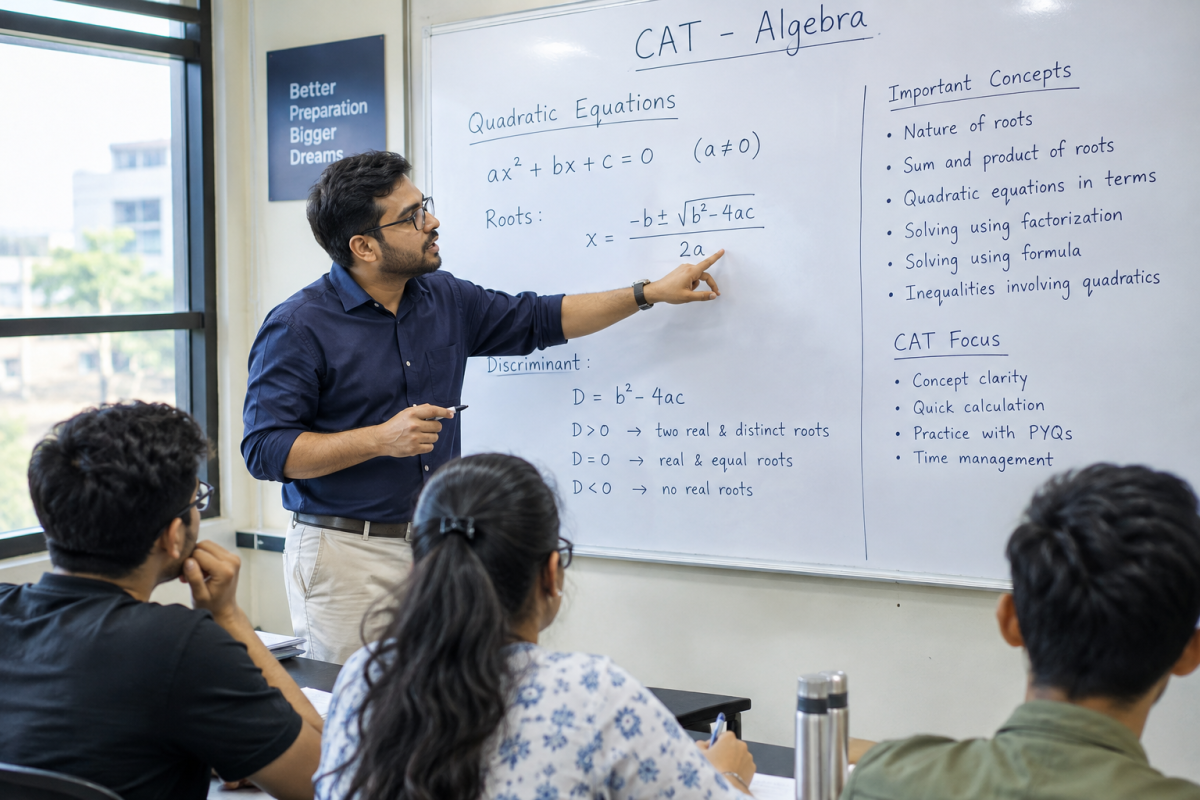
CAT Algebra Preparation 2026: Topics, Strategy, Questions and Study Plan
Published on: 05-Oct-2026 | Author:
Master CAT algebra preparation for 2026 with important topics, a practical study strategy, question-selection tips, common mistakes, and a 30-day plan for CAT Quant.
CAT Algebra Preparation 2026: Topics, Strategy, Questions and Study Plan
Table of Contents
-
What CAT algebra preparation means
-
Important CAT algebra topics
-
Topic-wise strategy
-
30-day CAT algebra study plan
-
Question-selection strategy
-
CAT algebra mistakes and myths
-
Who should choose this approach?
-
FAQs
Most CAT aspirants do not lose marks in Algebra because the topic is impossible. They lose marks because they try to solve every question, memorise shortcuts without understanding them, or postpone Algebra until the final months.
CAT Algebra preparation is about learning how to convert a word problem into an equation, spotting patterns quickly, and leaving time-consuming questions without panic. CAT does not publish a fixed topic-wise syllabus, but Algebra has consistently been part of Quantitative Ability through areas such as equations, inequalities, logarithms, functions, polynomials, and sequences.pw+1
At Pathshalahub, Haris Faraz and the counselling team advise students to treat Algebra as a scoring skill, not as a school-maths burden. This guide will help you decide what to study first, how to practise, and when to skip.
CAT Algebra Preparation: Quick Overview
CAT is a computer-based exam with three sections: VARC, DILR, and QA. Recent CAT patterns have used sectional time limits, so Algebra preparation must include timed decision-making, not only untimed practice.mba.hitbullseye+1
Need help building a realistic CAT preparation routine? Read Pathshalahub’s CAT Quant preparation guide.
CAT Algebra Topics to Prepare
The CAT Algebra syllabus is not released as a formal official chapter list. However, analysis of past papers and established CAT preparation resources consistently identifies the following topics as relevant.mbauniverse+2
Start With These Topics
Begin with:
-
Algebraic identities and factorisation
-
Linear equations
-
Quadratic equations
-
Inequalities
-
Logarithms
These topics build the foundation for many other CAT Algebra questions. For example, a word problem may look like a ratio question but require a linear equation. A number-property question may finally become a quadratic equation.
CAT Algebra Preparation Strategy
Step 1: Build Equation Skills First
The biggest CAT Algebra skill is not formula recall. It is equation formation.
When a question says:
-
“The sum of two numbers is…”
-
“One quantity is three times another…”
-
“A value increases by…”
-
“The roots of an equation are…”
Pause and assign variables clearly. Then turn each statement into an equation.
Do not begin with shortcuts. First learn the standard method. Once the method is clear, use faster approaches such as substitution, option checking, or approximation.
Step 2: Learn Patterns, Not Random Questions
CAT often changes the language of questions, but the underlying structure repeats.
A useful practice rule: after solving each question, write one line explaining the model. For example: “This was a quadratic roots-and-coefficients question.” That habit helps you recognise the same model faster later.
CAT Algebra Topic-Wise Strategy
Do not aim to finish every advanced question. CAT rewards selection. Recent CAT analyses have continued to identify Algebra as an important QA area alongside Arithmetic, Geometry, Number System, and Modern Mathematics.news.careers360+1
CAT Algebra Question-Selection Strategy
You have limited time in QA. A strong student is not the one who attempts every Algebra question. A strong student knows which question deserves time.
Use the 30-Second Scan
Read the question once and ask:
-
Can I identify the topic?
-
Can I form an equation quickly?
-
Do I see a direct method?
-
Are the options useful for elimination?
-
Is the calculation likely to stay manageable?
This is especially important because CAT QA is one part of a three-section paper, and each section has a limited time window.insideiim+1
Want to understand what real CAT questions look like? Use CAT previous-year papers effectively instead of collecting endless random PDFs.
30-Day CAT Algebra Study Plan
Daily CAT Algebra Routine
If you are preparing in a short window, use this CAT preparation in 3 months guide to balance Algebra with VARC, DILR, and Arithmetic.
CAT Algebra Books and Resources
Do not buy five books at once. Finish one structured source, solve PYQs, and analyse errors. For a focused resource list, see best books for CAT preparation.
Common CAT Algebra Mistakes
CAT Algebra Myths vs Reality
CAT Algebra Preparation Flowchart
Choose weak Algebra topic
↓
Learn the basic concept
↓
Solve untimed examples
↓
Practise 20–30 topic questions
↓
Review every error
↓
Solve CAT previous-year questions
↓
Take timed sectional tests
↓
Improve question selection
↓
Revise error notebook before mocks
Skills Required for CAT Algebra
Benefits vs Drawbacks of Focusing on Algebra
Who Should Choose This Approach?
This CAT Algebra preparation approach is suitable for:
-
Students who know basic school mathematics but struggle with CAT-style wording.
-
Non-engineering students who need a structured Quant plan.
-
Students who make calculation or sign errors in Algebra.
-
Aspirants preparing for CAT along with XAT, NMAT, SNAP, or CMAT.
-
Working professionals who need short, high-quality practice sessions.
-
Students aiming for a balanced QA score rather than attempting every question.
Who Should Avoid This Approach?
This method may need adjustment if:
-
You have not revised basic fractions, percentages, and arithmetic at all.
-
You are spending all your study time on Algebra while ignoring VARC and DILR.
-
You are attempting advanced questions before mastering linear and quadratic equations.
-
Your CAT exam is very close and Algebra is a very weak area; focus first on your highest-return QA topics.
-
You use only videos but do not solve questions independently.
Best Option by Preparation Time
Best Option by Career Goal
Expert Tips From Pathshalahub
According to Haris Faraz, Career Counsellor with 14+ years of experience, students should not judge their CAT potential from one mock score. A mock is useful only when you identify whether the issue was concept clarity, question selection, speed, or exam pressure.
Use a simple three-colour system in your notebook:
-
Green: Questions solved correctly in under two minutes.
-
Yellow: Questions solved correctly but too slowly.
-
Red: Questions skipped, guessed, or solved incorrectly.
Your next revision session should focus mainly on yellow and red questions. This creates measurable improvement.
Still confused about how much Algebra you need for your target percentile? Get exam preparation guidance from Pathshalahub’s counselling team through the CAT 2026 exam page.
CAT Percentile and College Planning
CAT Algebra preparation supports your QA performance, but MBA admissions depend on your overall percentile, sectional performance, academics, work experience, interviews, and college-specific selection rules.
Use the CAT score and percentile predictor after mocks, then check the CAT percentile vs MBA college predictor guide.
Final Recommendation
CAT Algebra preparation becomes manageable when you stop treating it as a list of formulas. Learn to form equations, practise the common models, improve your question selection, and review every error.
For college planning after CAT, explore top MBA colleges accepting CAT scores in India. Reviewed by Haris Faraz — Career Counsellor with 14+ Years of Experience, Pathshalahub.
FAQs
Is Algebra important for CAT Quant?
Yes. Algebra is a recurring part of CAT Quantitative Ability, along with Arithmetic, Geometry, Number System, and Modern Mathematics. CAT does not publish a fixed topic-wise syllabus, so preparation should be based on recurring topics from previous papers.pw+1
What are the most important Algebra topics for CAT?
Prioritise linear equations, quadratic equations, inequalities, algebraic identities, logarithms, polynomials, functions, modulus, and sequences and series.
How many Algebra questions come in CAT?
The exact number changes by slot and year. Recent paper analyses show that Algebra remains an important QA area, often appearing alongside Arithmetic as a major contributor.news.careers360+1
Can a non-engineering student prepare Algebra for CAT?
Yes. CAT Algebra mainly needs clear fundamentals, regular practice, and good question selection. Begin with equations and identities rather than difficult shortcuts.
How should I start CAT algebra preparation?
Start with algebraic identities, factorisation, and linear equations. Then move to quadratic equations, inequalities, and logarithms. Solve topic-wise questions before attempting mixed tests.
Is NCERT enough for CAT Algebra preparation?
NCERT-level learning can help you rebuild concepts, but it is not enough by itself. You also need CAT-level practice, timed sectionals, and previous-year questions.
How can I improve speed in CAT Algebra?
Improve speed by recognising question patterns, using factorisation or substitution when appropriate, practising calculations mentally, and leaving questions that do not reveal a method quickly.
Should I attempt every Algebra question in CAT?
No. Attempt questions where you can identify a clear method and maintain accuracy. Spending too long on one difficult question can reduce your overall QA score.
How many questions should I practise daily for CAT Algebra?
A beginner can solve 10–15 questions daily with concept revision. An intermediate aspirant can solve 20–30 questions, including a few timed questions and error review.
Can CAT Algebra help in other MBA entrance exams?
Yes. Algebra concepts are useful for XAT, NMAT, SNAP, CMAT, and many other management entrance examinations, though their question style and time pressure differ.
Reviewed by Haris Faraz — Career Counsellor with 14+ Years of Experience | Pathshalahub

Discussion (0)
Add Comment
No comments yet. Be the first to share your thoughts!