
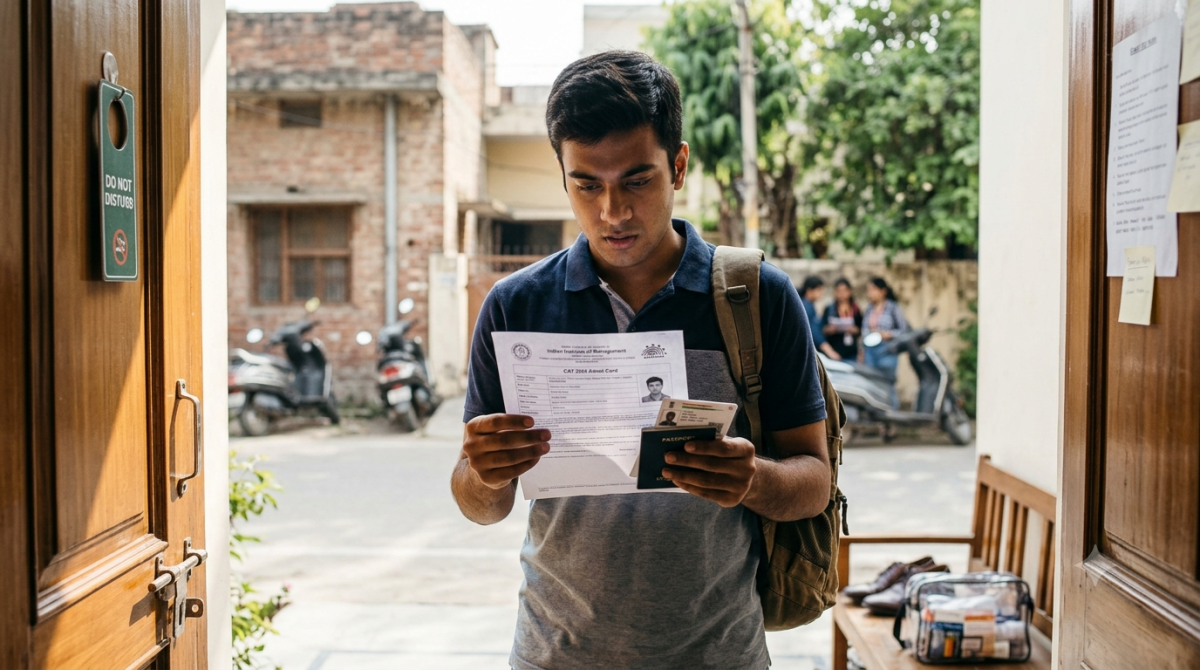
CAT Exam Day Strategy 2026: Checklist, Time Plan & Tips
Published on: 20-Oct-2026 | Author:
Follow this CAT exam day strategy for 2026: complete checklist, reporting time, documents, section-wise plan, negative-marking rules, and expert tips to stay calm and maximise your score.
CAT Exam Day Strategy 2026: Complete Checklist, Time Plan & Expert Tips
Most CAT aspirants lose marks not because they did not prepare, but because they panic in the first 10 minutes of the exam. A wrong set selection in DILR, rushing through VARC, or attempting too many QA questions can turn a strong preparation into an average percentile.
Your CAT exam day strategy should be simple: protect your accuracy, follow your practiced time plan, and make decisions based on the paper in front of you—not fear. This guide gives you a complete CAT 2026 exam-day checklist, reporting-time plan, section-wise approach, and last-minute tips.
Pathshalahub counsellors have guided MBA aspirants through CAT, XAT, SNAP, NMAT, and CMAT admissions for years. This article focuses only on what you can control on exam day.
Quick Summary: CAT Exam Day Strategy
| Area | What you should do |
|---|---|
| Reporting time | Reach the centre well before the reporting time on your admit card |
| Documents | Carry printed CAT admit card and valid original photo ID |
| Exam duration | 120 minutes; 40 minutes for each section |
| Sections | VARC, DILR, and QA in fixed order |
| Section switching | Not allowed before the section timer ends |
| Marking | +3 for correct; -1 for wrong MCQ; no negative marking for TITA |
| Core strategy | Select questions carefully, avoid ego attempts, and protect accuracy |
| After exam | Do not judge your percentile from the paper’s difficulty alone |
CAT 2026 is scheduled for November 29, 2026, in three slots. The computer-based test has three timed sections: VARC, DILR, and QA.
Table of Contents
-
What Is CAT Exam Day Strategy?
-
CAT 2026 Exam Day Schedule
-
Documents and Items to Carry
-
Night Before and Morning Routine
-
Section-wise CAT Exam Day Plan
-
Negative Marking and Attempt Rules
-
Common CAT Exam Day Mistakes
-
Myths vs Facts
-
Expert Tips from Pathshalahub Counsellors
-
FAQs
-
Final Advice
What Is CAT Exam Day Strategy?
A CAT exam day strategy is a pre-decided plan for how you will use your 120 minutes, select questions, handle pressure, and avoid avoidable mistakes.
CAT does not reward the student who attempts the most questions. It rewards the student who converts preparation into accurate attempts. Since MCQs carry negative marking, blind guessing can reduce your score. TITA questions do not have negative marking, but random guessing still wastes time.
Your exam-day plan should cover:
-
Reaching the centre on time
-
Carrying the right documents
-
Staying calm during biometric and security checks
-
Following a section-wise time plan
-
Choosing questions based on strength, not difficulty
-
Leaving low-confidence questions without guilt
Before exam day, revise your section-wise targets using the CAT time management strategy for VARC, DILR and QA. Your exam-day plan should be a lighter version of what you already practised in mocks.
Still unsure how many questions to target? Get exam preparation guidance from Pathshalahub counsellors.
CAT 2026 Exam Day Schedule
Your admit card is the final authority for your exam centre, slot, reporting time, and instructions. However, recent CAT slot-wise schedules have followed this broad pattern.
| Slot | Exam timing | Reporting time | Last entry allowed |
|---|---|---|---|
| Slot 1 | 8:30 AM to 10:30 AM | 7:00 AM | 8:15 AM |
| Slot 2 | 12:30 PM to 2:30 PM | 11:00 AM | 12:15 PM |
| Slot 3 | 4:30 PM to 6:30 PM | 3:00 PM | 4:15 PM |
Do not plan to reach “just on time.” Traffic, parking, security checks, document verification, and biometric registration can take longer than expected. Aim to reach at least 30–45 minutes before the reporting time.
CAT 2026 Exam Pattern
| Section | Questions | Time | Marking rule |
|---|---|---|---|
| VARC | 24 | 40 minutes | +3 correct; -1 wrong MCQ |
| DILR | 22 | 40 minutes | +3 correct; -1 wrong MCQ |
| QA | 22 | 40 minutes | +3 correct; -1 wrong MCQ |
| Total | 68 | 120 minutes | TITA: no negative marking |
The 68-question structure is based on the latest available CAT 2026 pattern updates; IIMs can adjust the exact question split, so treat your on-screen instructions as final.
Documents and Items to Carry
Keep everything ready the night before. Do not depend on a printout shop near the exam centre.
| Item | Required? | Important note |
|---|---|---|
| CAT admit card printout | Yes | Carry a clear colour or black-and-white printout |
| Original photo ID | Yes | Aadhaar, PAN, passport, voter ID, or driving licence as permitted |
| Same photo ID used during registration | Preferred | Avoid mismatch issues |
| PwD/scribe-related documents | If applicable | Carry supporting certificates as instructed |
| Simple water bottle | Check admit card | Follow the latest centre-specific rules |
| Transparent water bottle | If allowed | Avoid branded or coloured bottles |
| Medicines | If medically required | Carry prescription/support documents if needed |
Do not carry mobile phones, smartwatches, calculators, study material, bags, notes, wallets with electronic devices, or prohibited accessories unless the centre explicitly permits storage. CAT is a computer-based exam, and electronic devices are not allowed inside the testing lab.
Have a quick question about documents or centre rules? Chat with Pathshalahub on WhatsApp before exam day.
Night Before and Morning Routine
Your CAT exam day strategy starts the previous evening. Do not try to learn a new topic at 11 PM.
Night Before
-
Keep admit card, ID, and clothes ready.
-
Check the exam centre location and travel route.
-
Sleep for at least 6–7 hours.
-
Revise only formulas, error log, or short notes for 30–45 minutes.
-
Avoid a full-length mock on the previous day.
-
Set two alarms.
Exam Morning
-
Eat a light, familiar meal.
-
Avoid heavy, oily, or unfamiliar food.
-
Reach early, but do not stand outside discussing paper predictions.
-
Use the washroom before entering the centre.
-
Avoid last-minute “tips” from other candidates.
Your brain performs best when it is calm and familiar with routine. If you have followed a structured final-month plan, such as the CAT last 30 days preparation strategy, trust that process.
Section-wise CAT Exam Day Plan
CAT has a fixed section order: VARC → DILR → QA. You cannot move to another section before the 40-minute timer ends.
VARC: Start Calm, Not Fast
VARC is usually the first section, so it sets the tone for the paper. Many students rush the first RC passage and lose easy accuracy.
Your approach:
-
Spend the first 30–45 seconds scanning passage lengths and question types.
-
Start with a passage you understand quickly.
-
Read the passage with intent; do not memorise every detail.
-
Eliminate extreme, irrelevant, or unsupported options.
-
Do not attempt verbal ability questions randomly.
If a passage feels abstract, skip it and return later if time remains. For a deeper approach, revise the CAT Reading Comprehension strategy for VARC.
Target: Accuracy first. A calm 12–16 strong attempts are usually better than 20 rushed attempts.
DILR: Select Sets Like an Investor
DILR is where most students either gain confidence or lose control. The biggest exam-day skill is set selection.
Follow this flow:
-
Scan all sets in the first 2–3 minutes.
-
Mark sets as Easy, Medium, or Leave.
-
Start with a set where the data is clear and questions look solvable.
-
Do not spend more than 8–10 minutes on a stuck set.
-
Move on without emotional attachment.
A set may look short but contain hidden complexity. Conversely, a long-looking set may be very direct. Use the framework in CAT DILR sets: how to select and solve sets.
Target: Choose 3–5 workable sets rather than trying to solve everything.
QA: Attempt What You Know First
QA often feels stressful because students see unfamiliar questions early. Do not let one tough question decide your section.
Your QA plan:
-
First pass: solve direct arithmetic, algebra, and familiar questions.
-
Second pass: return to medium questions.
-
Final minutes: review marked questions only if time permits.
-
Avoid long calculations when a smarter shortcut may exist.
Arithmetic usually offers scoring opportunities for well-prepared students. Revise high-weightage areas through the CAT arithmetic preparation guide.
Target: Build a strong base of confident attempts before chasing difficult questions.
Want a percentile-specific plan? Explore the CAT 90 percentile strategy, CAT 95 percentile strategy, or CAT 99 percentile strategy.
Negative Marking and Attempt Rules
CAT uses a simple but important marking system.
| Question type | Correct answer | Wrong answer | Unattempted |
|---|---|---|---|
| MCQ | +3 | -1 | 0 |
| TITA | +3 | 0 | 0 |
This means:
-
Do not guess MCQs with two or more plausible options unless you can eliminate at least two choices confidently.
-
TITA questions have no negative marking, but they still consume time.
-
A wrong MCQ costs you one mark; a wrong TITA costs you time but not marks.
-
Leaving a question is not failure; it is score protection.
As Haris Faraz, Career Counsellor with 14+ years of experience, advises: “On CAT exam day, your first job is to avoid self-created damage. Select questions you can actually solve, then use remaining time for calculated risks.”
How to Handle a Difficult CAT Section
Every CAT slot has a section that feels uncomfortable. Your response matters more than the paper’s difficulty.
-
Take one deep breath; do not check the clock repeatedly.
-
Reduce your target from “maximum attempts” to “clean attempts.”
-
Search for 2–3 easy questions instead of forcing a tough set.
-
Do not compare your performance with students from other slots.
-
Remember: normalization and percentile depend on relative performance, not just raw score.
If DILR feels difficult, shift to shorter, more direct sets. If QA feels difficult, focus on arithmetic and algebra basics. If VARC feels difficult, slow down and improve option elimination.
Common CAT Exam Day Mistakes
| Mistake | Why it hurts | What to do instead |
|---|---|---|
| Reaching late | You may miss entry or feel rushed | Leave with a large travel buffer |
| Carrying wrong ID | Entry can be denied | Match ID with admit card instructions |
| Starting with the hardest question | Kills confidence | Start with familiar, solvable questions |
| Spending 12 minutes on one DILR set | Reduces total attempts | Set a strict exit rule |
| Guessing MCQs blindly | Negative marking reduces score | Guess only after elimination |
| Changing strategy mid-exam | Creates confusion | Follow your practised mock strategy |
| Panicking after a tough section | Affects next 40 minutes | Reset after every section |
| Discussing paper after exam | Increases anxiety | Focus on next steps, not predictions |
Myths vs Facts
| Myth | Fact |
|---|---|
| You must attempt every question | No. Accuracy and smart selection matter more |
| TITA questions should always be attempted | They have no negative marking, but random guessing wastes time |
| A difficult paper means a low percentile | Percentile is relative; a tough paper can normalize favourably |
| You can switch sections if you finish early | No. CAT has a strict 40-minute sectional limit |
| Exam-day luck decides your result | Preparation, selection, and calm execution decide most of it |
| You must solve all DILR sets | Even top scorers leave sets strategically |
Expert Tips from Pathshalahub Counsellors
-
Do only what you practised. Exam day is not the time for a new shortcut or new question type.
-
Use a 3-question rule in DILR. If three questions in a set feel unclear, leave the set.
-
Protect VARC accuracy. The first section should build confidence, not anxiety.
-
Use the on-screen timer wisely. Check it at fixed checkpoints, not every minute.
-
Do not chase 99 percentile during the exam. Chase clean attempts; percentile follows.
-
Keep a small error checklist in mind: misreading, calculation slip, wrong option, and time sink.
If you want to understand how previous papers behave, practise with CAT previous-year papers before exam day. They help you recognise question styles without adding new pressure.
After the CAT Exam
Once the exam ends, avoid slot-wise answer-key debates and “I attempted 30 questions” conversations. They create unnecessary stress.
Your next steps should be:
-
Keep your admit card safely until the admission cycle ends.
-
Wait for the official response sheet and answer key process.
-
Start researching MBA colleges based on realistic percentile bands.
-
Prepare for WAT, GD, and PI rounds if you expect a good score.
-
Keep backup exams such as XAT, SNAP, NMAT, or CMAT in mind.
Explore the top MBA entrance exams in India so one exam result does not decide your entire MBA journey.
For college shortlisting, check top MBA colleges accepting CAT scores. If budget is a concern, review MBA colleges under ₹5 lakh fees.
Get exam preparation guidance and personalised MBA college planning from Pathshalahub counsellors — free.
MBA College Options to Explore After CAT 2026
| College | Why students consider it |
|---|---|
| PIBM | Industry-oriented MBA/PGDM exposure and placement support |
| IIEBM | Management-focused learning environment |
| Shanti Business School | Practical business education and industry interface |
| Alliance University | Private university MBA pathway |
| GIBS | Business school option for management aspirants |
| Imperial Business School | Management programme option for CAT aspirants |
| ISBR | Business school pathway for MBA/PGDM aspirants |
College choice should depend on fees, specialisation, placements, location, ROI, and interview conversion—not only on your CAT percentile.
FAQs
1. What is the best CAT exam day strategy?
The best CAT exam day strategy is to reach early, carry the correct documents, follow your practised section-wise time plan, and attempt only questions you can solve with confidence. Focus on accuracy, avoid blind MCQ guessing, and leave time-consuming DILR sets quickly.
2. What should I carry on CAT exam day?
Carry a printed CAT admit card and a valid original photo ID. If applicable, carry PwD or medical supporting documents. Follow your admit card for the exact list of permitted items, as centre rules can vary.
3. What is the reporting time for CAT 2026?
Your exact reporting time will be mentioned on your CAT admit card. In recent CAT schedules, reporting times have been around 7:00 AM for Slot 1, 11:00 AM for Slot 2, and 3:00 PM for Slot 3.
4. Can I switch between VARC, DILR, and QA during CAT?
No. CAT allots 40 minutes to each section, and candidates cannot move to another section before the current section’s time ends.
5. Should I attempt TITA questions in CAT?
Attempt TITA questions when you can solve them or make a reasonable calculated attempt. TITA questions do not have negative marking, but guessing them randomly wastes valuable time.
6. How many questions should I attempt in CAT?
There is no fixed number. Your attempt target should depend on accuracy, section difficulty, and your target percentile. A useful rule is to attempt questions where you expect at least a 70–80% chance of being correct. For detailed targets, read how many questions to attempt in CAT.
7. What should I do if the DILR section is very tough?
Do not panic. Spend 2–3 minutes scanning all sets, choose the clearest ones, and leave complex sets early. Focus on partial accuracy and direct questions rather than trying to crack every puzzle.
8. Can I wear formal clothes to the CAT exam centre?
You do not need formal clothes. Wear comfortable, weather-appropriate clothing without prohibited accessories. Avoid jewellery, smartwatches, and items that may delay security checks.
9. How can I stay calm during the CAT exam?
Use a fixed pre-exam routine: light food, early reporting, controlled breathing, and no last-minute discussions. During the exam, focus on one question at a time and reset mentally after every section.
10. Why do I need a counsellor to help with MBA admission after CAT?
A counsellor helps you match your CAT score, budget, academic profile, work experience, and career goal with the right MBA colleges. Pathshalahub counsellors can also guide you through application deadlines, interviews, scholarships, and admission documentation.
Final Advice
Your CAT exam day strategy should not be complicated. Reach early, carry the right documents, start calmly, select questions wisely, and protect accuracy in every section.
You have already done the hard work through mocks, revision, and practice. On exam day, your only job is to execute your plan with discipline. If you feel confused about college options after CAT, book a free counselling session with Haris Faraz and the Pathshalahub team.
Get exam preparation guidance and personalised MBA admission support from Pathshalahub today.
Reviewed by Haris Faraz — Career Counsellor with 14+ Years of Experience | Pathshalahub

Discussion (0)
Add Comment
No comments yet. Be the first to share your thoughts!